
HEACalculator






HEACalculator is a Python tool for calculating phenomenological parameters based on thermodynamics and physics to predict the formation of solid solutions in High Entropy Alloys (HEAs).
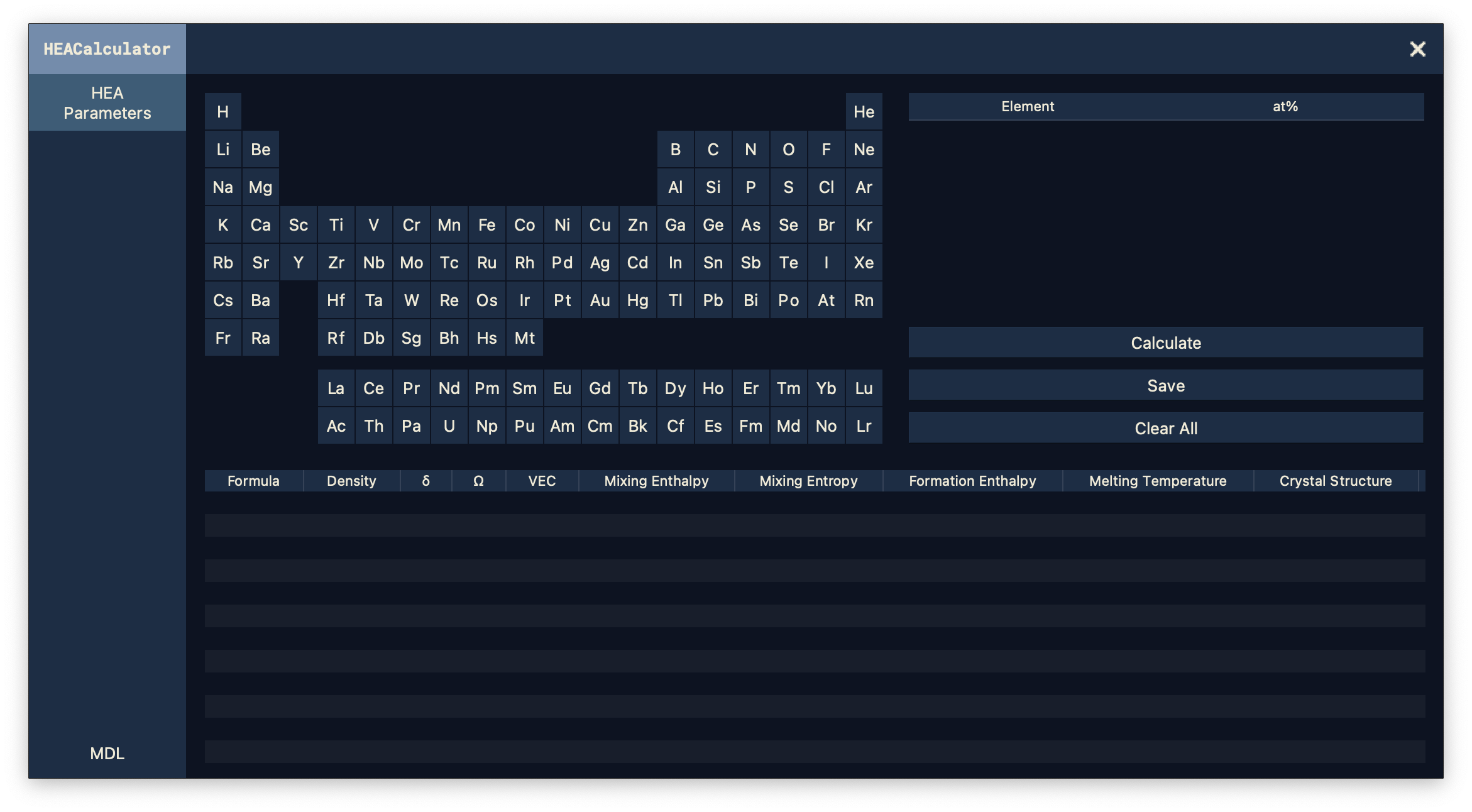
What is HEACalculator?
High Entropy Alloys (HEAs) are multi-principal-element alloys that are difficult to characterize from composition alone. HEACalculator takes a composition as input, computes thermodynamic and physical parameters, and runs those values through eight published solid-solution formation models.
A CLI (built on Typer), a GUI (built with PyQt6), and a Python API all use the same calculation core.
Features
Property calculations
- Density (g/cm\(^3\))
- Melting Temperature (K)
- Mixing Enthalpy, \(\Delta H_{\text{mix}}\) (kJ/mol)
- Miedema Mixing Enthalpy, \(\Delta H_{\text{mix}}^{\text{Miedema}}\) (kJ/mol)
- Mixing Entropy, \(\Delta S_{\text{mix}}\) (J/K·mol)
- Formation Enthalpy, \(\Delta H_f\) (meV/atom)
- Minimum Formation Enthalpy, min. \(\Delta H_f\) (meV/atom)
- Valence Electron Concentration (VEC)
- Hume-Rothery Electron-to-Atom Ratio (e/a)
Structural parameters
- Atomic Size Difference, \(\delta\) (%)
- Atomic Size Difference (CN12), \(\delta_{\text{CN12}}\) (%)
- Electronegativity Difference, \(\Delta\chi_{\text{Allen}}\) (%)
- Electronegativity Difference, \(\Delta\chi_{\text{Pauling}}\) (%)
- Omega, \(\Omega\)
- Gamma, \(\gamma\)
- Lambda, \(\lambda\)
- Phi, \(\phi\)
- \(\Delta G_{SS}\)
- \(\Delta G_{\text{max}}\)
Solid-solution formation prediction
- Expected Microstructure (FCC / BCC / HCP / BCC+FCC)
- 8 independent published models (Yang & Zhang, Guo, Wang, Singh, Ye, Troparevsky, Senkov & Miracle, King)
Quick Start
See Installation & Quick Start for project installs, uv tool installs, and pip-based setups. See Usage for command examples and the uv tool workflow.
Citation
If you use HEACalculator in your research, please cite the following:
Sarıtürk, D., Kalay, Y. E., & Arróyave, R. (2026). HEACalculator: An Open-Source Python Tool for Thermodynamic Property Calculation and Solid Solution Prediction in High-Entropy Alloys. arXiv. https://doi.org/10.48550/arXiv.2606.19661
Sarıtürk, D. (2019). HEACalculator. Zenodo. https://doi.org/10.5281/zenodo.3590318
BibTeX
@misc{sariturk_2026_arxiv,
  author    = {Sarıtürk, Doğuhan and Kalay, Yunus Eren and Arróyave, Raymundo},
  title     = {{HEACalculator}: An Open-Source {Python} Tool for Thermodynamic Property Calculation and Solid Solution Prediction in High-Entropy Alloys},
  year      = 2026,
  publisher = {arXiv},
  doi       = {10.48550/arXiv.2606.19661},
  url       = {https://doi.org/10.48550/arXiv.2606.19661},
}

@software{sariturk_2019_3590318,
  author    = {Sarıtürk, Doğuhan},
  title     = {HEACalculator},
  year      = 2019,
  publisher = {Zenodo},
  doi       = {10.5281/zenodo.3590318},
  url       = {https://doi.org/10.5281/zenodo.3590318},
}